Our Salvation Came from a Herd of 85 Beautiful Goats and a Community of Kind, Caring Neighbors
By Dr. Brent Ridge and Josh Kilmer-Purcell | July 10, 2025 11:35 am
Beekman 1802 co-founders share how they launched a successful business in the middle of a recession with their not-so-secret formula: kindness.

We launched Beekman 1802 in one of New York State’s poorest counties with no funding—during a punishing recession. As our story illustrates, it doesn’t matter where you live, how you identify, or how many resources you have at your disposal. If you dedicate yourself to following tried-and-true wisdom, you can do it too.
Our adventure started in 2008, at the beginning of the devastating global financial crisis. Both of us lost our glamorous New York City jobs within the space of a month—Brent was a physician and the senior vice president of health and wellness for Martha Stewart Living Omnimedia. Josh was an executive creative director at a top advertising agency. Suddenly unable to pay the mortgage on our historic farm in Sharon Springs, New York, which we’d bought as a weekend getaway only one year earlier, we made a major decision. Rather than declaring bankruptcy and walking away from our debt as so many other homeowners were doing, we decided that we would try to find a way to run our farm as a profitable business.
At first, the odds seemed stacked against us. The Great Recession was raging, and we lacked capital, having sunk our life savings into buying the farm. We’d never earned our living as entrepreneurs before, and knew little about farming. For the first two months after making our decision, we hunkered down on our property, depressed and wondering what to do. We had long been on a track toward conventional material success, and now that we had abandoned it—or it had abandoned us—the challenges before us seemed insurmountable.
Our salvation came from a herd of eighty- five beautiful goats and a community of Kind, caring Neighbors.
Months earlier, while we were still employed, we’d helped a local farmer who was losing his farm, agreeing that he could move to a small caretaker’s cottage on our property and keep his dairy goats on our land. In lieu of rent, he agreed to share some of his goat milk with us. Another Neighbor showed us how to craft soap with the milk, and we taught ourselves how to code an e-commerce site, take product photography, and process online payments.
Other local farmers and artisans were struggling financially and lacked media and marketing skills, so we began helping them market their products as well as our own on our website. At first, Beekman 1802, as we called our business, didn’t generate much profit—it had been strictly a fun hobby we pursued during precious time off from our city jobs. But after losing our jobs, we realized we’d have to turn our hobby into a real business that would allow us to pay the mortgage and keep the farm.
To grow the business beyond simply e-commerce, Brent dropped by New York City department stores, showing them samples of our soap. Everyone turned him down except Henri Bendel, a luxury department store then located on Fifth Avenue. Bendel’s allowed Brent to set up a small table during the holiday season with Beekman products. Each day for two months, Brent got up at 4 a.m., made the three-hour trip into the city, spent the entire day manning our display and interacting with shoppers, then returned to the farm late at night.
The work was exhausting, but it led to our company’s first major order—52,000 bars of soap for the retail chain Anthropologie. We had no money to hire workers, but fortunately, our Neighbors helped us fulfill the order as a favor, coming to our farmhouse and wrapping bars of soap around the dining room table.
Over the next few years, we sold our handmade, locally sourced products via our website and a small storefront we opened in Sharon Springs. As we first envisioned it, Beekman 1802 was to be an umbrella lifestyle brand selling products in multiple consumer categories. But as the years went by, our science-backed goat milk personal-care products grew more and more popular, and we eventually pivoted to focus exclusively on the beauty category.
By 2020 we were one of the largest independent beauty companies in America, and after taking on additional investment in 2021, we’ve expanded globally.
From those early days when we celebrated our first “grand weekend” (over $1,000 in revenue at our Sharon Springs store) to today when our annual retail sales surpass the nine-figure mark, our day-to-day operations are still guided by the maxims you’ll find in this book.
We are voracious readers of biographies, especially those of business leaders reflecting on their own journeys. It always strikes us that no matter the vertiginous heights of success or the specific industry, almost every single business icon will attribute their success to some basic principle. Warren Buffett (The Lessons and Rules for Success) said, “The price is what you pay, the value is what you get.” Mark Cuban (How to Win at the Sport of Business) referenced, “The best way to predict the future is to invent it.” “Simplicity is the ultimate sophistication,” is attributed to Steve Jobs in Think Differently. Howard Schultz, the founder of Starbucks, who changed how many of us start our day, wrote in his book From the Ground Up that “how you spend your money shows your values.” Sir Richard Branson (The Virgin Way) has a few gems: “Say less, contribute more”; “Zig when everyone else is zagging”; “Hire your weaknesses”; and “Fortune favors the bold.”
Virtually every business book ever written and every commencement speech ever given has encouraged readers and listeners to “follow your passion” if you want to find success. Doesn’t this all sound familiar? They are all variations of things you’ve heard before. We fully anticipate that absolutely nothing that you read [our book] will be new to you. But what we hope will be new is how we teach you to listen and actually incorporate this advice into your own life and business.
. . .
While this is a business book, it’s also a book about love. Passion. Diligence. Dedication. And most of all, Kindness. A book built on forty years of hard work, big successes, and shattering failures. A book that’s a lot like life.
When we first launched, we didn’t know the specifics of our eventual business model. But we did know one thing: we wanted to build a good company, not merely a successful one. We wanted to sell high-quality products that would enrich our customers’ lives and create a strong, diverse, caring community. We wanted to make the world a better place by spreading Kindness and Neighborliness. And we wanted to build a business that would last.
We were determined that our personal and corporate mission of spreading Kindness would be real, not an empty marketing slogan. (Please note that we always capitalize “Kindness” to illustrate and constantly remind ourselves just how important it is.) We wanted to build our business the right way, and that meant treating buyers of our products not as generic customers but as Neighbors—members of a community who deserved care, respect, and recognition. In fact, we actually don’t use the word “customer” or “consumer” when referring to our own. As you’ll see throughout this book, we, and our entire company, call our customers “Neighbors.”
While other startups took investor money, sought explosive but unprofitable growth, and aimed for a quick, lucrative exit, we focused on winning over one new Neighbor at a time— both online and in person. Rather than mobilizing expensive advertising to attract throngs of new customers, we eschewed investor money and relied primarily on generating positive PR around our personal stories and business values. It was a less glamorous but far more satisfying way to build a business, and it enabled our brand to create a community of highly enthusiastic Neighbors and grow it organically and in an enduring fashion.
Marrying the traditional sensibility we encountered in our little town with our big-city media savvy, we parlayed our experiences as gentlemen farmers into a book deal and a reality TV show, The Fabulous Beekman Boys, aired on Planet Green and the Cooking Channel, both of which gained significant exposure for Beekman 1802. In 2012, thanks to help from one of the show’s fans, we were invited to appear on the twenty-first season of The Amazing Race. Although we were clearly underdogs, we wound up winning the competition, again bringing awareness of Beekman 1802 to an audience of millions.
Seventeen years later, Beekman 1802 is one of America’s most admired companies, and we’ve built it around simple, old-fashioned human values. Millions of Beekman Neighbors turn to our all-natural, ethically sourced soaps, skin-care products, and other offerings to help them stay healthy and look their best. While trendier competitors have come and gone, Beekman 1802 has grown into a thriving community devoted to the ideal of Kindness.
To succeed with Beekman 1802, we had to figure out our own formula. The strategies and tactics that worked best for us embodied timeless proverbs that our parents and grandparents had taught us—the greatest-of-all- time principles for good living that also can be applied to any business. We chose to turn our backs on the trendy management advice of the day, and we took principled actions instead. We soon realized that this insight amounted to a fresh playbook that anyone can use to build a Kinder and more profitable business in the twenty-first century.
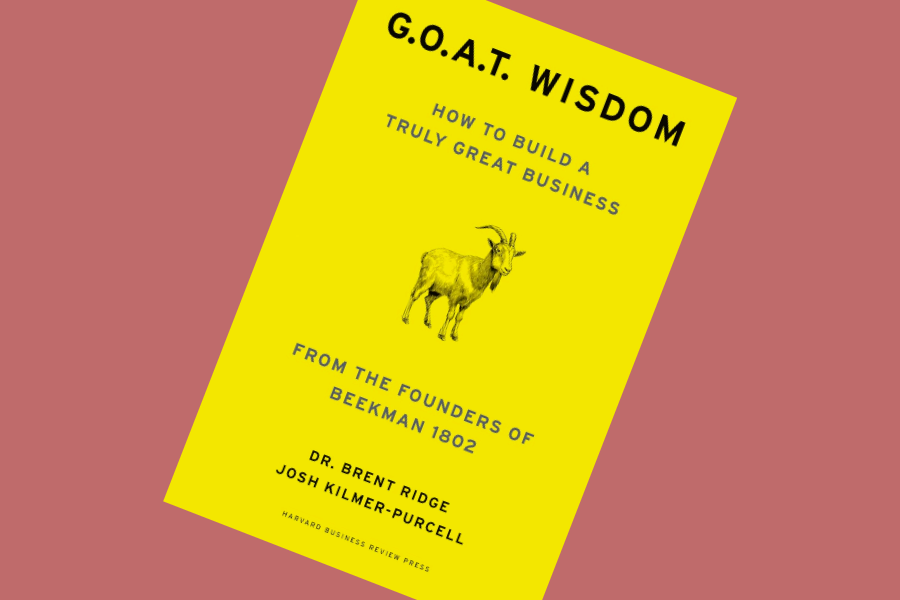
Reprinted by permission of Harvard Business Review Press. Adapted from G.O.A.T. WISDOM: How to Build A Truly Great Business—From the Founders of Beekman 1802 by Dr. Brent Ridge and Josh Kilmer-Purcell. Copyright 2025 Dr. Brent Ridge and Josh Kilmer-Purcell. All rights reserved.
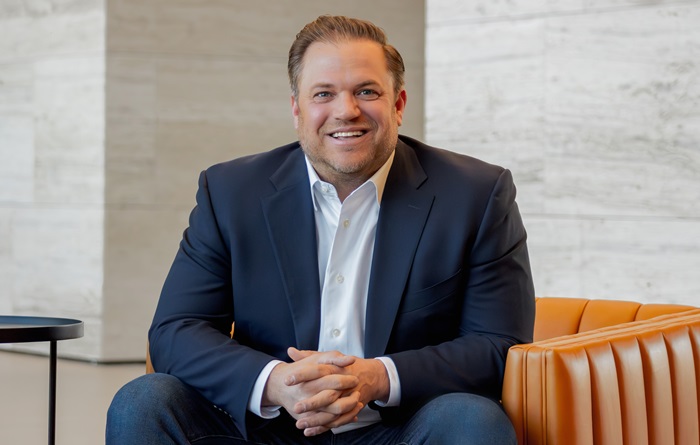
Brent Ridge, M.D., and Josh Kilmer-Purcell co-founded Beekman 1802 in 2008 and have led the company ever since.
Prior to his entrepreneurial career, Dr. Brent Ridge was vice president of healthy living at Martha Stewart Living Omnimedia. He also built a distinguished medical career as a specialist in geriatric medicine, completing a fellowship at Mount Sinai School of Medicine and joining the faculty there as an assistant professor. He founded the Martha Stewart Center for Living at the Mount Sinai Hospital, one of the world’s leading geriatric centers.
Josh Kilmer-Purcell is a New York Times bestselling author, with three memoirs to his credit: I Am Not Myself These Days, Candy Everybody Wants, and The Bucolic Plague. Prior to founding Beekman 1802, Josh was an award-winning creative director at several top New York City advertising agencies, serving clients including Delta Air Lines, Absolut Vodka, Target, Nestlé and Unilever.