
The Hidden Forces Behind Rural Poverty
By Don Larson | August 20, 2026 10:55 am
Sunshine Nuts’ visionary CEO shines a blistering light on why smallholder farmers remain trapped in poverty and challenges responsible parties to effect change.

For more than 30 years, I have lived on both sides of one of the world’s most misunderstood industries. Earlier in my career, I served as head of Cocoa Purchasing for Hershey Chocolate, responsible for sourcing one of the world’s largest agricultural commodities. Like every major chocolate company, Hershey was frequently accused of exploiting farmers and profiting from poverty, even though we purchased cocoa through large multinational suppliers and had no direct relationship with the farmers themselves.
Today, I stand at the opposite end of the supply chain. I own a vertically integrated cashew company in Mozambique where I have lived for 15 years. We buy directly from smallholder farmers, process our own cashews, export premium consumer products around the world, and reinvest heavily into the rural communities where our crops originate.
Having spent my career in both global cocoa and African cashews, I have come to an unexpected conclusion. Although the crops are different, the forces keeping smallholder farmers trapped in poverty are remarkably similar. And contrary to popular belief, poverty is rarely maintained by greed alone.
It is maintained by systems. Systems that are widely understood. Systems that are largely accepted. Systems that are extraordinarily difficult to change.
Ironically, nearly everyone operating within those systems often has good intentions. Banks are trying to reduce financial risk. Governments are trying to ensure accountability. Development agencies are trying to protect public funds. Corporations are trying to remain competitive. Traders are trying to maximize returns.
Each participant behaves rationally (except for the unethical ones who intend to exploit). Yet together, they often produce precisely the opposite outcome from what everyone claims to want to reduce: persistent rural poverty.
This realization has changed everything I thought I knew about agricultural development.
The First Hidden Force: Liquidity Controls the Harvest
Most people believe agricultural markets are driven by supply and demand. They are not. They are driven by liquidity. Whoever controls cash during harvest controls the crop. Harvest seasons are incredibly short. Farmers cannot postpone selling because school fees cannot wait, medical emergencies cannot wait, and hunger cannot wait.
If an ethical company promises a better price next week while an exploiter intentionally offers below market pricing to make a profit for himself at the expense of the farmers because they arrive today carrying cash, almost every farmer will sell today. The farmer does not see it as exploitation; he sees it as survival.
Farmers are acting rationally. Once cash begins flowing through a region, market power shifts almost immediately. By the time slower, more responsible buyers arrive, much of the harvest has already disappeared. The season has effectively been decided. The exploitation occurs in how that liquidity is used.
In 2012, shortly after moving to Mozambique, I traveled to the country’s largest cashew-growing region to understand the market firsthand. I went into rural communities and asked farmers what they were being paid for their raw cashews. They consistently told me they were receiving 5 meticais per kilogram. Yet I had just visited two factories located not far from those villages whose exterior signs advertised purchasing prices of 20 and 21 meticais per kilogram. The farmers were receiving only about one-quarter of the price publicly available only a short distance away.
Wanting to confirm what I had heard, I asked the local government administrator to speak with farmers throughout the area and document what they had received. I was later sent a written report listing the farmers’ names, the number of cashew trees they owned (including one farmer with more than 400 trees) and the prices they had been paid. The farmers reported receiving 5 meticais per kilogram for most of the season. Only near the end of the season did the price increase to 10 meticais per kilogram. Compared with the nearby factories’ posted prices, they had received approximately 25% of the available local price for most of the season and only about 50% even after the increase.
These were not farmers living in an area disconnected from the cashew industry. Their communities were near several factories associated with a multinational processor. Nevertheless, the farmers lacked transportation, immediate access to competing buyers, market information and the financial ability to wait for a better offer. They accepted the cash available to them because their families needed it immediately. I was devastated to see such a severe and documented disparity, and to realize that the price itself could be only the beginning of the exploitation.
The abuse of the farmer is further compounded by many additional offensive tactics. Scales are manipulated in favor of the buyer. Volume measurements are inaccurate. Liquor and consumer goods are exchanged at inflated values instead of cash.
Farmers desperate for immediate money accept terms they would never choose under different circumstances. I have seen every one of these practices firsthand. This is why I have come to believe that poverty is maintained not simply through low prices but through control of liquidity.
Whoever controls cash during harvest controls the supply chain. Whoever controls the supply chain ultimately decides how much of the final consumer value reaches the farmer, whether ethically or unethically.
The irony is that unethical buyers often enter the market first, knowingly rushing in to take advantage of the farming families desperate for cash. This is usually the farmer’s only source of income a year. Meanwhile, ethical companies obey the law and wait for the official buying season to begin.
The Second Hidden Force: In Agriculture, Timing Matters More Than Financing
Development institutions celebrate financing approvals. Agriculture celebrates timing. Those are not the same thing.
Trees operate according to biological calendars. Banks operate according to administrative calendars. The two rarely align.
Our own company learned this lesson the hard way. We secured development financing specifically intended to improve smallholder farmer incomes. The financing was expected to be approved within two months. Instead, it took almost 11 months. By the time the money arrived, the three-month buying season had already ended. The farmers had already sold well below market value. The traders had already bought. The opportunity had disappeared.
Instead of purchasing directly from farming communities, we were forced to buy inventory from opportunistic traders who had accumulated stock months earlier. We paid more than 50% above normal market prices. Because our financing still had not arrived when purchases needed to be made, we also required expensive short-term financing, adding roughly another 10% in financing costs simply to bridge the delay.
The raw material was among the poorest we had ever processed. By the end of every buying season, what remains is often the rejected portion of the crop — small kernels, defective nuts and rotten inventory. Poor raw material lowered factory performance, reduced production efficiency, weakened sales execution and, ultimately, reduced profitability. Additional waste from defective cashews compounded our losses.
The greatest tragedy is that delayed financing can actually eliminate the very businesses trying to pay farmers fairly. When ethical companies disappear, unethical buyers gain even greater freedom to dictate prices. One delayed financing decision erased much of the purpose for which the development financing had been created. This fund was purposely designed to reach and uplift the smallholder farmers. All intentions were lost.
That experience fundamentally changed my understanding of agricultural finance. Money arriving after harvest is not merely delayed. Economically, it is largely irrelevant. Agriculture does not wait for paperwork.
The Third Hidden Force: Why Ethical Companies Often Lose
There is another uncomfortable reality that receives far too little attention. The companies trying hardest to improve rural livelihoods frequently begin every season at a competitive disadvantage.
They comply with labor regulations, invest in traceability, maintain food safety certifications, undergo independent audits and pay taxes and duties. They publish impact reports.
Meanwhile, informal traders often operate under far fewer obligations and move into farming communities long before compliant companies are legally able to purchase.
Ethical companies therefore begin every harvest carrying higher costs before buying their first kilogram of product. When working capital also arrives late, competing becomes nearly impossible. Good intentions cannot overcome structural disadvantages.
The Fourth Hidden Force: Africa Exports Commodities with No Value Addition Captured
Africa exports enormous volumes of agricultural commodities. Unfortunately, as a result, it often exports the least valuable part of agriculture — the raw product.
Farmers grow the crop. Someone else shells it, roasts it, brands it, packages it and markets it — therefore earning the highest margins.
Every stage adds value. Most of those stages occur outside of the developing countries where the product is grown and sourced. The countries producing the crop frequently receive the smallest share of the final consumer dollar.
Vertical integration changes that equation. Local processing creates manufacturing jobs. Packaging creates skilled employment. Branding creates intellectual property. Exporting finished consumer products allows producing countries to participate in far more of the value chain.
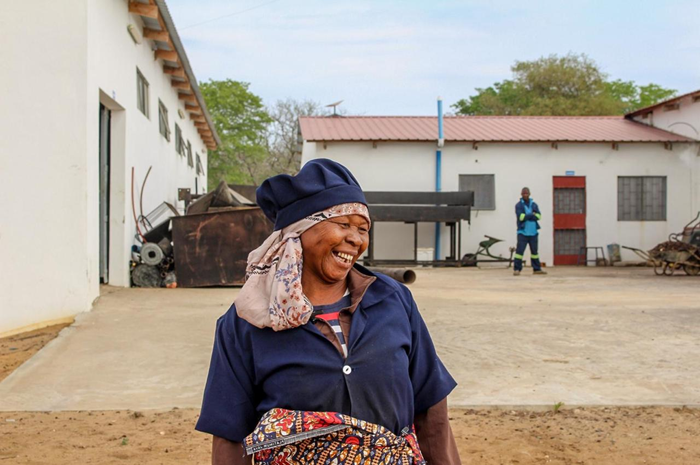
Rabeca smiles outside Sunshine’s rural cashew processing facility. Local processing allows more of the economic value created by agriculture to remain where the crop is grown.
Rabeca (pictured), smiling outside Sunshine’s rural cashew processing facility, is wearing the Sunshine uniform. Every uniform represents more than a job — it represents stable income, dignity, and an opportunity to participate in a value chain that has traditionally bypassed rural communities.
Behind every discussion of commodity prices, financing and international trade is a person like Rabeca. When value is added locally instead of exported elsewhere, opportunity begins to replace dependency.
Prosperity follows value creation, not simply production. That is one of the fundamental reasons Africa continues to struggle with poverty. The existing system makes it remarkably difficult for producing countries to move beyond exporting raw commodities and capture greater value at home.
The Fifth Hidden Force: Working Capital Is More Powerful Than Vision
In 2015, we entered the United States with a premium cashew brand grown, roasted and packaged in Mozambique. Our first retail customer was Whole Foods Market. For most food companies, securing shelf space at Whole Foods represents a dream. When Whole Foods accepts a new brand, other retailers notice. Demand followed. Opportunity followed. Growth should have followed.
Instead, for more than 11 years, one obstacle has repeatedly limited our expansion. Not consumer demand. Not product quality. Not retailer interest. Working capital.
Every year, we have had opportunities to become dramatically larger. Every year, we have lacked sufficient working capital to purchase enough raw cashews during harvest simply to meet existing demand. People often assume businesses fail because customers do not want their products. However, the truth is that many times businesses fail because they cannot finance success.
The Sixth Hidden Force: The Missing Form of Capital
Banks are comfortable financing buildings. Agriculture rarely needs another building. Agriculture needs inventory, seasonal working capital, financing that moves as quickly as harvest itself.
Working capital should not be viewed as an ordinary loan product. In agriculture, it is infrastructure. Without it, ethical businesses cannot compete. Without competition, farmers lose choices. Without choices, poverty persists.
A Different Way Forward
After decades inside global agricultural commodities, I have reached one conclusion: Poverty is not primarily a production problem. It is a capital allocation problem.
One practical step Sunshine has taken is helping the farming communities from which we purchase organize into cooperatives. An isolated farmer has little negotiating strength, limited access to market information and few ways to challenge an unfair buyer. A cooperative changes that balance. It allows us to communicate prices, quality requirements and purchasing plans efficiently through elected community leaders. More importantly, it gives farmers a collective voice and greater strength when negotiating with buyers. Sunshine’s objective is not merely to pay a fair price ourselves, but to help create farming communities that are increasingly capable of recognizing, resisting and, ultimately, ending exploitation.
This same philosophy lies behind our Sunshine Villages initiative in Mozambique. Our objective is to integrate the entire rural development equation — farmer organization, working capital, improved productivity, better planting material, local processing, manufacturing, market access and community investment. The goal is not simply to purchase crops. It is to give farmers greater control over their economic future and redesign the economics of rural development.
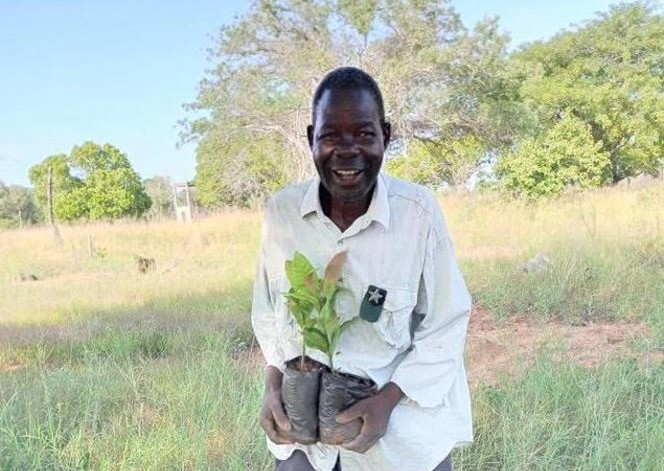
Fernando prepares to plant new cashew tree seedlings.
For smallholder farmers like Fernando (pictured), each tree represents more than agriculture — it is a long-term investment in income, family security and hope. But those investments only fulfill their potential when farmers have access to fair markets, working capital and opportunities to participate in more of the agricultural value chain.
People like Fernando do not need rescuing from hard work. They are already working. What they need is access to honest markets and the opportunity to benefit fairly from the value they create.
Will we succeed? Only time will answer that question.
But after spending my career inside two of the world’s largest agricultural commodity industries, I have become convinced that the current structure will never eliminate poverty if those with economic power continue becoming wealthier by taking advantage of those with the least.
The system needs champions willing to confront the hidden forces that sustain poverty — not merely treat its symptoms.
One Question
If governments, development banks, philanthropists, impact investors and agricultural lenders genuinely want to reduce poverty among the world’s smallholder farmers, I would ask them to consider one question before approving any agricultural financing proposal:
“Will this capital reach the market before the harvest begins?”
If the answer is no, then the opportunity to transform lives may already have passed.
Agriculture does not wait for paperwork. Neither does poverty.
Don Larson is founder and CEO of Sunshine Nut Company.