Top 66 People-Centric Leaders of 2025 Prove Taking Care of People Is Taking Care of Business
By Chris Benguhe, RaeAnne Marsh and Elaine Pofeldt | January 15, 2026 11:28 am
The Dave Alexander Center for Social Capital proudly announces its top Social Capital business leaders of the past year.
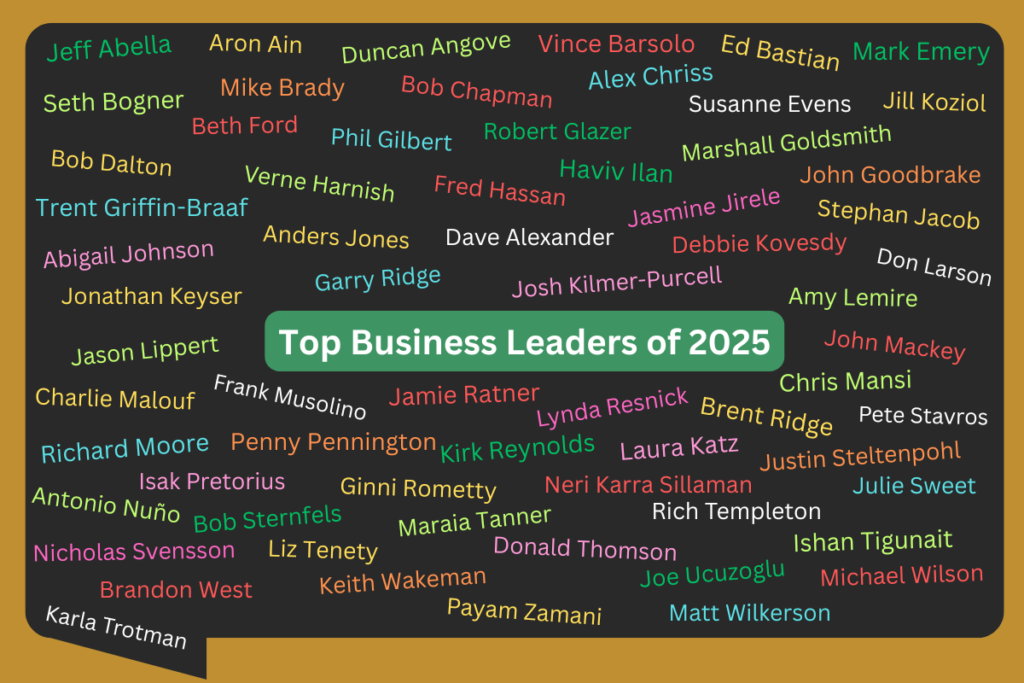
At the Dave Alexander Center for Social Capital, we believe now is the time to embrace people‑centric business through the concept of Social Capital. And let those leaders who are taking care of people not only lead the way but be honored for their light and leadership. (Image: DAC)
As we exuberantly kick off 2026, and our third year at our Center for Social Capital, we celebrate a banner year for people-centric leadership in 2025. The growing reality that so many CEOs are discovering is that the biggest risks are no longer purely financial or operational — they are human. Declining trust, employee disengagement, burnout and social isolation are showing up as critical performance issues inside companies.
However, for those who are willing not only to recognize this canary in the coal mine, but also be proactive and do something to save the future prosperity and success of their companies, the opportunities for unprecedented prosperity are just waiting to be capitalized on by protecting and maximizing the single greatest resource a business has — its people!
And those aren’t just nice-sounding words or our opinion. It’s backed up by a whole lot of mounting data.
As we reported earlier in the year: Businesses founded or restructured around both profit and purpose through people-centric principles are outperforming their peers across multiple metrics, according to a 2025 report by Chief Executives for Corporate Purpose — a coalition of more than 200 CEOs from companies like IBM, Johnson & Johnson and PepsiCo. They demonstrate:
- 58% higher revenue growth
- 63% higher returns on invested capital
Beyond this, the research found:
- 76% of investors now expect companies to define and act on a clear purpose.
- 93% believe purpose is essential to long-term strategy and value creation.
Furthermore, as we noted, the need to embrace people-centric policies is stronger than ever, with an increasing segment of the population — especially young people — reporting being lonely, hopeless, economically struggling, confused, overrun by social media, over-stimulated and convinced they will never do even as well as their parents did in life.
But the good news is that after hundreds of interviews with high-profile CEOs, founders and leadership experts — plus a mounting library of insightful articles written by them — the Dave Alexander Center for Social Capital is seeing a clear shift: More and more leaders are starting to treat trust, connection and dignity as business infrastructure, not culture language.
Top executives and business greats like Ed Bastian, Jasmine Jirele, Tony Capuano, Penny Pennington, Pete Stavros, Garry Ridge, Marshall Goldsmith, Bob Chapman and so many more have spoken with the Center about how people-centric leadership is changing business decision-making at scale.
What’s emerging from those conversations?
- Trust is becoming a balance sheet issue, influencing retention, risk and long-term value.
- Employee ownership is moving from fringe idea to serious strategy as leaders look for durable engagement models.
- AI delivers its greatest impact when paired with human-centered leadership.
- Leaders who adhere to real and actionable principles like our own Ten Core Principles of Social Capital Leaders are outperforming the competition and the stock market.
Ironically, this is not a new idea but an old one that fell out of fashion in the late twentieth century for some shortsighted reasons. It is an idea first proposed by the venerable philosopher Adam Smith. As he explains in “The Theory of Moral Sentiments,” the seemingly simple concept of “self-interest” is not as simple as it seems. In the long run, it means keeping in mind the complex “interests” all humans have. We not only want to be prosperous but want to enjoy living in a community where our families, our friends, our neighbors and our fellow citizens are happy and prosperous as well. And at the end of the day, that is actually what capitalism can and should achieve.
But in the 1980s, Jack Welch threw all that out the window — along with a whole lot of employees — when he reshaped General Electric by elevating shareholder value and quarterly performance as the company’s top priorities. This shift led to aggressive cost cutting, widespread layoffs and the now infamous “rank and yank” system, which required managers to fire the bottom 10% of employees every year. Welch insisted that GE must be number one or two in every market it operated in, prompting the divestiture of any business that didn’t meet that standard. His approach — focused on financial performance over employee stability — helped institutionalize a high-pressure, fear-driven culture across American business. Many companies adopted similar practices, accelerating a national shift toward short-term results at the expense of long-term sustainability.
And now we have real, documented evidence — from economists, business historians, management scholars and even former GE executives — that the Welch-era shift and philosophy contributed to long-term structural damage in American business as well as GE itself.
Jack Welch’s model — forced ranking, mass layoffs and shareholder-first short-termism — spread across corporate America and produced measurable long-term damage. Studies show forced ranking increased turnover up to 20% and reduced innovation by 24%. Layoffs cut profitability for years. Ultimately, it diverted investment from workers and R&D to buybacks, which soared from 4% to more than 50% of profits. Meanwhile, U.S. competitiveness, wage growth and productivity gains all declined. GE itself crumbled under the weight of this misguided strategy from a $600-billion giant to a shadow of its former glory that was forced to massively restructure in order to survive, becoming the clearest proof that the system ultimately undermined American business.

“To us, empowering employees means creating an environment where people feel valued, supported and encouraged to do their best work and grow beyond it.” —Jeff Abella (Image: iStock/ LoveTheWind)
But people-centric business is coming back with a bang, and we continue to be excited to lead the way. Because this is not just about business, but about how business will lead society and the world in general. For the first time in the history of the world, there is the potential for every single human on earth to share in the abundance and wealth that has been created by a massive global expansion of business and profit — and for the businesses that lead this revolution to achieve unparalleled success.
In keeping with this, we believe now is the time to embrace people‑centric business through the concept of Social Capital. And it’s time to let those leaders who are taking care of people — their customers, their employees and people in the community — not only lead the way but be honored for their light and leadership.
Jeff Abella, CEO & Co-Founder (with Ishan Tigunait) of Moka Origins
April 2025 Why Empowering Others in Business Has Never Been More Important
“To us, empowering employees means creating an environment where people feel valued, supported and encouraged to do their best work and grow beyond it. Especially in today’s world, where uncertainty is a real challenge, empowerment has to go beyond motivation.
“At Moka Origins, we’ve established a code of ethics and a culture centered around open communication and active listening. This enables our leadership team to stay closely connected to the needs of each team member and provide meaningful, personalized support. We offer flexibility in schedules; invest in professional development through training, online courses, and internal workshops; and foster an environment that prioritizes personal well-being.”
And that’s really just for starters when it comes to how these models of real and realized people-centric leadership build and grow their company by taking care of their people. Ultimately this leads to tremendous, sustainable and profitable business success because their employees feel that Jeff and Ishan genuinely support, value and connect with them on a very real, effectual and deeply human level.
“That’s how we build trust, create accountability and actively shape a culture where every voice matters.”
Aron Ain, Executive Chair at UKG
January 2025 The Un-Leader in Action
“Let’s face it, egotistical, self-interested or self-absorbed leaders of any stripe usually don’t inspire people very much. These leaders might elicit fear, respect or admiration, but not affection. And you need affection if you’re going to spur employees to pour their hearts into their work every single day.
“There’s a name for the kind of humble CEO I aspire to be. I’ll call him or her the ‘Un-Leader.’”
Aron Ain, who took the helm as CEO of UKG when Kronos merged with Ultimate Software and who later transitioned to serve as executive chair and member of the board of directors wowed us with his unrelenting belief in and practice of the power of humility and how it transforms a leaders from authoritarian to egalitarian, enabling them far greater access and support of their employees.
“Do you ever sense that your people are withholding important information — that you don’t know what’s really going on? It may be that your people feel uncomfortable communicating. They don’t trust you because, to them, you’re different. Inaccessible. Unapproachable. You’re The Boss, and it feels scary to be themselves around you. So, they keep silent, and you remain ignorant about important facets of the business, not knowing what you don’t know. Over time, that lack of knowledge takes a significant toll.
“Don’t be The Boss. Be a human being. Invite your team members in by staying humble and putting them on your level.”
Dave Alexander, Founder & Managing Member at Caljet of America
February 2025 Authenticity Rules: Business Leaders’ Tips on How to Be Real – and Why
August 2025 Empathy at Work Is Broken: Employees Are Hurting – and Losing Faith in Leadership
“‘Authenticity!’
“This word is defined by me using the twelve words of the Scout Law: Trustworthy, Loyal, Helpful, Friendly, Courteous, Kind, Obedient, Cheerful, Thrifty, Brave, Clean and Reverent.
“My father was a Scout and led me in these principles by example. When I became a Scout, I accepted the Scout Law, and it drove me to become an Eagle Scout.
“I would now add the word ‘communication’ to the Law, to help teach the Law to others and make the world a better place. If you are authentic, people you interact with will know who you are, and all in your circle of acquaintances will have a better life!!!
“A typical talk that I give to a new employee is: ‘To grow personally and prosper here at our company, you must be trustworthy — to yourself, your family, the company and our customers and suppliers.’”

“If you are authentic, people you interact with will know who you are, and all in your circle of acquaintances will have a better life!” —Dave Alexander (Image: iStock/ Svetlozar Hristov)
Duncan Angove, CEO at Blue Yonder
August 2025 Empathy at Work Is Broken: Employees Are Hurting – and Losing Faith in Leadership
“Empathy lies at the heart of my leadership philosophy, guiding my approach to decision-making, communication and relationship-building. I believe effective leadership is about genuinely connecting with and understanding the needs and aspirations of those we lead. And to do that, I believe leaders must also be humble by always being open to feedback and new perspectives and ways of looking at the world.
“Furthermore, empathy transcends mere internal dynamics and extends to our interactions with customers and partners. Drawing from my engineering background, I inherently approach empathy as a crucial component in the development process. By deeply understanding the needs, challenges and aspirations of our stakeholders, we engineer updates and enhancements that go beyond mere functionality. This unique perspective allows us to craft solutions that not only address immediate concerns but also resonate deeply, making a meaningful and lasting impact on our customers’ experiences. In maximizing customer value, we don’t just consider the technical aspects but also the human element, ensuring our products and solutions align seamlessly with the diverse needs and aspirations of our users.”
Vince Barsolo, CEO at Televerde
April 2025 Why Empowering Others in Business Has Never Been More Important
August 2025 A CEO Who Offers Women a Route from Incarceration to Hope and Prosperity
September 2025 Business Can Be the Ultimate American Community Organizer
“Since 1994, we have partnered with first the State of Arizona for the ability to work with incarcerated women. And the mission of the company is to provide training and development to these individuals in sales and marketing, so that upon their release, they can land gainful employment and support themselves and their families and have a much better chance at a successful future.
“At Televerde, empowerment starts with respect — owed respect for the humanity and potential of each person, and earned respect through the trust and accountability we build together. It’s not about ping pong tables or free lunches; those things are nice, but they don’t change lives. What changes lives is going deep — creating a culture that genuinely values every individual’s contributions and provides them with what they’ve often never had before: meaningful opportunities, clear guidance and a sense of purpose.
“Because of our unique model, many of the women we work with have gone their entire lives — and particularly their time in prison — without feeling respected. When we create an environment where they are heard, supported, and trusted, it’s transformative. True empowerment means showing people that they matter, that their voice counts and that their work has real impact — every single day.”
Ed Bastian, CEO at Delta Air Lines
April 2025 Why Empowering Others in Business Has Never Been More Important
June 2025 The Well-Being Wake-Up Call: Work Burnout Is at DEFCON ONE!
“At Delta, our wellness strategy enables our people to be their best and enhances their sense of purpose, belonging and affinity by providing high-value health and wellness offerings. Our Delta Wellness team takes a holistic approach to wellness — supporting our people from a physical, emotional, social and financial perspective. Over the last year, Delta has continued to enhance our employee wellness benefits, expanding our national network of pharmacies, launching a new program for nutrition and making in-network care more accessible. These offerings are a result of our annual company-wide survey, which provides a quantitative and qualitative assessment of our people’s total wellness. We strongly believe in a feedback-driven, people‑first philosophy, which allows us to elevate the employee experience while achieving a culture of safety, high performance and care.
“One specific program I am especially proud of is Delta’s Emergency Savings Program, which allows eligible employees to earn up to $1,000 from Delta to fuel their emergency savings after completing a financial education and coaching program and contributing to an emergency savings account. The goal of this program is to give our people peace of mind by contributing to their financial wellness and helping to prepare them for the unexpected.
“At Delta, we do not only want our people to be well, but we want them to flourish. We know in order to take great care of our customers, our people must first take care of themselves.”
Seth Bogner, Chairman & CEO at HeartPoint Global
August 2025 Empathy at Work Is Broken: Employees Are Hurting – and Losing Faith in Leadership
“To me, empathy is the ability to genuinely understand and share the feelings of others. Empathy requires active listening, deep understanding and thoughtful action to support and connect with others meaningfully.
“In the context of leadership, empathy means recognizing the emotions and perspectives of team members and using that understanding to guide interactions and decisions. It’s about creating a supportive work environment, fostering open communication and building strong, trust-based relationships. By being empathetic, a leader can better address the needs of their team, motivate them effectively and navigate challenging situations with sensitivity and care. Empathy is not just a soft skill but a critical leadership capability that enhances communication, promotes collaboration and drives overall team success.”
Michael Brady, CEO at 40 Million Owners (formerly CEO Greyston Bakery)
February 2025 Authenticity Rules: Business Leaders’ Tips on How to Be Real – and Why
March 2025 The Force Multiplier: Why Investors and Businesses Are Betting on Employee Ownership
November 2025 Fairness IS a Powerful Profit Center, and It’s The Right Thing To Do
“The greatest challenge to fairness in business today is inertia. Organizations cling to systems that fail both people and performance. Hiring practices screen out potential in favor of pedigree. Advancement favors familiarity over merit. Ownership structures exclude the workers who create the value.
“The greatest opportunity lies in making fairness a competitive advantage. Companies that embed equity into their business model through inclusive hiring, transparent advancement pathways and broad-based ownership don’t just do good. They perform better. They attract top talent, drive innovation and build the resilience needed for long-term success. Organizations that integrate fairness into operations consistently outpace peers in employee engagement, creative problem-solving and sustainable growth. When people see a clear path forward and share in the value they create, they invest more deeply in outcomes. Fairness isn’t separate from strategy. It is strategy.”
Bob Chapman, Chairman & Former CEO at Barry-Wehmiller Companies
July 2025 The Ultimate Business Productivity Hack: Listening
“The conventional wisdom is that leaders tell people what to do and how to act,” Bob explains. “Time and again, I’ve said that listening is the most important thing a leader can do. But it transcends the leader role. Listening is the most important thing we, as humans, can do for one another. It shows empathy, it shows you care and, most importantly, it shows the person you are listening to that they matter.
“At Barry-Wehmiller, we have found that listening — deep, reflective listening — is one of the master keys to our Truly Human Leadership culture.”
Bob began transforming his leadership style into what he calls Truly Human Leadership almost 30 years ago, emphasizing caring for employees like family, and prioritizing purpose and people alongside performance. A few years into this new program, he began holding “Listening Sessions” to discuss their new set of beliefs and asked the very important question: “What can we do better?”
And he really listened to the answers. The result: a total company rework that led to one of the most people-centric — and successful — organizations in the world.
“At Barry-Wehmiller, we have found that listening — deep, reflective listening — is one of the master keys to our Truly Human Leadership culture.” —Bob Chapman (Image: iStock/ Dadan)
Alex Chriss, President & CEO at PayPal
May 2025 Who’s Keeping the Faith at Work? A Whole Lot of Business Leaders!
On its website, PayPal states, “We believe all employees have the right to bring their whole self to work. Faith and worldviews are core to who we are — our values and beliefs — and to how we conduct business. The mission of Believe is to foster an inclusive work culture and to promote holistic wellbeing by providing a forum to openly exercise and celebrate all faiths and worldviews while working. Believe exists to create awareness and understanding of faith, hope, love, empathy, respect for one another and service toward our customers, communities and co-workers.”
Need we, or Alex, say more?
Bob Dalton, Founder & CEO at Sackcloth & Ashes
September 2025 Business Can Be the Ultimate American Community Organizer
“Peter Block writes in his book Community that the goal isn’t community; the goal is belonging. People are asking three questions when it comes to belonging:
- Do you see me?
- Do you hear me?
- Does what I say mean anything to you?
“Your executive team is asking those questions. Your team members are asking those questions. Your customers are asking those questions. Your family members are asking those questions.
“If you want the hack to building strong relationships and communities, focus your efforts on making sure the people in your life and work can say, ‘Yes’ to those three questions.”
Mark Emery, Co-Founder & CEO at Juvo Jobs
February 2025 Authenticity Rules: Business Leaders’ Tips on How to Be Real – and Why
August 2025 Empathy at Work Is Broken: Employees Are Hurting – and Losing Faith in Leadership
“When I was younger, I thought empathy just meant being nice or feeling bad for someone. Over the years, I’ve realized real empathy takes action — it’s about being present, slowing down, and sometimes even changing what you do because you truly understand what someone else is going through. Building Juvo360 has really driven that home for me. Working to help hourly workers and the businesses that rely on them has shown me that empathy is not just a ‘soft skill’; it’s a leadership tool that moves relationships, decisions and results forward.”
Susanne Evens, Founder & CEO at AAA Translation
February 2025 Authenticity Rules: Business Leaders’ Tips on How to Be Real – and Why
“Authenticity is a cornerstone of successful businesses because it builds trust and fosters meaningful connections with customers. In a marketplace crowded with competitors, consumers gravitate toward brands that feel genuine and transparent. When a business communicates honestly about its values, practices and intentions, it establishes credibility, which is essential for cultivating long-term customer loyalty. Authenticity also enables businesses to stand out by highlighting their unique identity, creating an emotional connection that goes beyond transactional relationships. Customers appreciate brands that are consistent and true to their promises, which leads to stronger brand loyalty and positive word-of-mouth recommendations.”
Beth Ford, President & CEO at Land O’Lakes Inc.
November 2025 Fairness IS a Powerful Profit Center, and It’s The Right Thing To Do
“Our industry is a broad and critical subset of our economy from the American farmer to businesses, such as the cooperatives I lead to the rural communities that both support and benefit from the success and strength of our food supply.
“We’re focusing on the things that are most important to our members, their families and to their businesses. And from my perspective, I don’t get involved in politics. We don’t talk politics. We talk policies that are enablers for farmers, for the food supply.
“Working together and including diverse voices and ideas is rooted in Land O’Lakes’ history as a cooperative. Our employees and our members need to always feel heard and valued for who they are.”
Phil Gilbert, Founder of Gilbert Workshop LLC, Former VP at IBM
November 2025 Change Is an Offering, Not a Mandate
Phil Gilbert is best known for leading IBM’s 21st century transformation as the company’s general manager of Design. After selling his third startup to IBM in 2010, Phil was asked by IBM in 2012 to use design thinking, coupled with agile, to update how IBM’s teams worked. The transformation became the subject of a Harvard Business School case study, the documentary film The Loop, and feature articles in The New York Times and Fortune Magazine.
“The problem IBM faced in achieving change was virtually identical to the problems I faced when launching a startup: How do we get people to change to something new when it seems easier to stay with what they’ve got?
“The answer was always the same: You make it dramatically easier for them to solve their problem, and you improve the quality of their outcome.
“In order to lead change, you turn change itself into the product. You invite employees to buy in, and you lavish attention and resources on your earliest adopters. You don’t mandate change, you offer change.
“This insight proved to be the central animating factor for everything that followed. It was the magic trick of our entire transformation — how we got hundreds of thousands of people to embrace change of their own free will.
“Our aim was to provide a product that was so desirable it would be worth paying for. It would be, in a word, irresistible.”
Robert Glazer, Founder & Chairman at Acceleration Partners
June 2025 Staying Open to Changing Your Mind: The Antidote to Decision Fatigue
October 2025 ‘The Compass Within’: How Will It Lead to Your Authentic Leadership Style?
November 2025 Empathy in the Workplace Isn’t About Being a Pushover, According to Bob Glazer
As Robert Glazer sees it, empathy in leadership isn’t just about “being nice.” It’s about understanding what drives and motivates your team, which, in turn, means taking time to learn their backstories.
“You might find out your super aggressive salesperson who seems over-focused on the commission grew up in abject poverty, and in the back of their mind they’re just afraid about ever going back there and not having enough,” Robert says.
The understanding and empathy that results can head off discord and misalignment in the workplace as he sees it. “Particularly when you’re trying to resolve conflicts and communications, that stuff is there …” he says. “The more I understand someone, the more I understand … what drives them or their back stories, [the more] it does help resolve things and solve some things.”
Robert brings this mindset to his work as founder and chairman of the board of Acceleration Partners, which helps leading brands grow their affiliate marketing partnerships with strategic support and local resources. He is also host and creator of the “Elevate” podcast and author of the “Friday Forward” newsletter.
In running Acceleration Partners, Glazer sees relationship-building as a key foundation of achieving company goals. “You need the performance and the objectives, but you also need the relationship,” he says. “Those allow you to have nuanced conversations.”
That said, Robert challenges the idea that a company should operate like a family — an approach that might support toxic behavior. “I’ve actually never liked the terminology around ‘We’re a family,’” he says. “Because, actually, to me, a family is like, ‘Oh, we excuse the drunk uncle who’s making inappropriate comments at the wedding and things.’”
Marshall Goldsmith, Founder of marshallgoldsmith.com
March 2025 Authentic Leadership: Beyond Checking the Box : Dave Alexander Center for Social Capital
October 2025 Cracking the New Code of Business Excellence
“Excellence isn’t just about performance — it’s about purpose.
“Too often, I see talented people equating excellence with perfection — believing that flawless execution in their current role is the surest path to long-term success.
“It’s a trap.
“Another essential part of managing excellence — especially for leaders — is understanding that being great at what you do is only half the equation. The other half is being recognized for it. You have to earn credibility twice: first through competence, then through visibility. Doing excellent work earns you internal credibility. Ensuring that others see, understand and value that work earns you external credibility — and that’s what expands your influence. As Drucker reminded us: ‘Every decision in the world is made by the person who has the power to make the decision.’
“Excellence means combining skill with courage — doing the work that matters and ensuring it creates impact where it matters most.”

“Excellence isn’t just about performance — it’s about purpose.” —Marshall Goldsmith (Image: iStock/ Supatman)
John Goodbrake, Owner & CEO at Master’s Transportation
May 2025 Who’s Keeping the Faith at Work? A Whole Lot of Business Leaders!
“At Master’s Transportation, our identity as a faith-based organization is reflected in our name and rooted in our mission: moving people forward. However, we recognize that our mission applies to everyone, regardless of their beliefs. We serve and support individuals from all backgrounds with the same level of care, respect and excellence,” says John Goodbrake, owner and CEO of Master’s Transportation.
“We practice tolerance of discussions of faith by creating a workplace culture grounded in mutual respect, open dialogue and compassion. While our faith informs how we lead, serve and grow, we never impose our beliefs on others. Instead, we aim to live out our values — integrity, service and dignity — so that our faith is seen in how we treat people, not just in what we say.
“By fostering an environment where all employees feel valued and safe to express who they are, we uphold the true spirit of our mission. This not only builds trust but also reflects how faith can work in all places, through kindness, empathy, and shared purpose.”
Trent Griffin-Braaf, Founder of Tech Valley Shuttle and Success Map Initiative™
November 2025 Fairness IS a Powerful Profit Center, and It’s The Right Thing To Do
“Fairness of opportunity means every person has access to the tools, information and pathways needed to advance — not just the ones who already know how to navigate systems. It’s the intentional removal of invisible barriers that limit people based on background, history, race or zip code. True fairness is not about lowering standards; it’s about ensuring that everyone has a real, supported path to meet and exceed those standards. In practice, fairness requires structures — not slogans. It shows up in hiring pipelines, onboarding support, mentorship access, performance review transparency and leadership development that includes all talent, not just the already-connected.
“Fairness of opportunity is about creating the conditions.
“Fairness of outcome is about the results those conditions produce.
“You can’t guarantee identical outcomes — people will always bring different talents, choices and ambitions — but you can ensure that no group is systematically disadvantaged in the process. When organizations only track performance outcomes without examining the journey to get there, inequity hides in plain sight. When we measure both — the opportunity and the outcome — we can see where systems need restructuring. Fairness is not a moment of charity; it is a sustained system of access, accountability and growth.”
Verne Harnish, Owner & CEO of Scaling Up
February 2025 Authenticity Rules: Business Leaders’ Tips on How to Be Real – and Why : Dave Alexander Center for Social Capital :
“‛Peace and Love’ — that’s our new P&L at our executive education firm Scaling Up. It started with me, the CEO, doing ‘the work’ last year with a hypnotherapist and undergoing a hero’s journey with the Beckley Foundation.
“To be authentic around the ‘old’ me was part of the problem at my firms. Now that I’m continuing to heal, this new ‘P&L’ approach is paying dividends since the team can see that I’m modelling the way.
“From how we respond to customers to the way we deliver our services, everything is now aligning around a way that is better — and is authentic because I changed to match.”
Fred Hassan, Director at Warburg Pincus and Former Chairman & CEO at Schering Plough
August 2025 Empathy at Work Is Broken: Employees Are Hurting – and Losing Faith in Leadership
“Empathy begins with deep self-awareness and extends to understanding how customers, teams, competitors and stakeholders feel and behave. It shapes how leaders communicate expectations, instill confidence, course-correct with credibility and celebrate wins. Organizations rich in empathy outperform those that rely solely on metrics and pressure. Outperformance doesn’t come from table-pounding — it comes from building belief, coaching with authenticity and creating environments where people feel seen and supported. David Ricks, CEO of Eli Lilly, exemplifies this: His humility and openness earn trust from every level of the company — a key reason he stands out in CEO of the Year evaluations.
“Empathetic leadership also fuels innovation. It enables psychological safety, encourages bold ideas and peer-to-peer team spirit, and drives faster execution. Emotional intelligence, once seen as optional, is now essential. Business acumen is the baseline — but leaders who pair it with empathy inspire accountability, loyalty and performance that exceeds expectations. As the AI revolution accelerates, the edge won’t come from algorithms alone. It will come from leaders who know when to lean into data — and when to lead with heart.”
Josh Kilmer-Purcell, Co-Founder (with Brent Ridge) of Beekman1802
February 2025 Authenticity Rules: Business Leaders’ Tips on How to Be Real – and Why
July 2025 Kindness Is the Key Ingredient in Soap Maker BEEKMAN 1802’s Business Model
July 2025 Our Salvation Came from a Herd of 85 Beautiful Goats and a Community of Kind, Caring Neighbors
When Josh Kilmer-Purcell and Dr. Brent Ridge co-founded Beekman 1802, their dream was to build their successful business around the principle of kindness.
Brent, a physician in a hospital, and Josh, a corporate advertising professional, started the company in upstate New York, in one of the state’s most impoverished counties, with no funding when both lost their jobs during the 2008 recession. They used goat milk from the Sharon Springs farm they’d bought as a weekend getaway to create skincare products. A neighbor who was losing his own farm gifted them his 80 goats, offering to help them run the farm if they let him live in their cottage.
“We had no plans of starting a business,” says Josh. “We only say that that first act of kindness taking in our neighbor was what eventually started our business, without even knowing we were going to have one.”
Since then, they have grown Beekman 1802 into a nearly $100 million company by focusing on treating every customer as a “neighbor” and infusing kindness into their products, hiring and marketing.
“It’s not kindness just as a marketing term. We actually do the research. We fund the research, actual scientific research to show how kindness can improve an organization, how it can improve your bottom line. We work with Kindness.org. We just released a study last year, for the first time ever, being able to actually measure kindness within an organization, scientifically measured kindness. And then you can attribute it to the bottom line and the performance of an organization. So, for us, it’s not just fluffy, ‘Oh we’re a good nice kind company.’ It’s like, if we’re kind, we will win.”
Haviv Ilan, President & CEO at Texas Instruments;
May 2025 Who’s Keeping the Faith at Work? A Whole Lot of Business Leaders!
When Texas Instruments leadership transitioned from former CEO Rich Templeton — who continues with the company as chairman of the board and is also honored in this article — to president and CEO Haviv Ilan in 2023, the company continued its commitment to practicing diversity and inclusion — and faith is an important part of that equation.
Among the employee-led ERGs are three that are faith-based — Muslim Employee Network, Christian Employee Network and Jewish Employee Network — which were founded in 2001. These help build a bridge between different ideologies and provide the employees with opportunities to learn more about their colleagues’ beliefs and traditions.
To support employees in living their faith, TI offers time-off flexibility around religious holidays and serenity rooms for prayers or worship. The serenity rooms at several of TI’s campuses are open 24 hours a day, 7 days a week to any employee and serve as a quiet space for prayer or meditation.
TI, as a global company, is well aware it has a workforce that represents a wide range of diverse worldviews. In offering faith-based ERGs, TI provides employees with opportunities to drive greater understanding across cultural boundaries.

“The notion that ‘you can’t talk about religion at work’ never resonated with me.” —Stephan Jacob (Image: iStock/ gustavofrazao)
Stephan Jacob, Co-Founder & Chief Global Officer at Cotopaxi
May 2025 Who’s Keeping the Faith at Work? A Whole Lot of Business Leaders!
“The notion that ‘you can’t talk about religion at work’ never resonated with me.
“We don’t just use the ‘heart’ emoji on Zoom/Google Meet; we actually use the word ‘love’ a lot.
“By far my favorite meetings at Cotopaxi are our ‘Life Hikes,’ which we host every two weeks. One Cotopaxi team member gets ‘on stage’ to share their life story however they deem fit. Everybody else just listens. I can’t tell you how proud and grateful I am for the candor with which our team has shared their life experiences, struggles, faith and all, and the wonderful, judgment-free reception and outpouring of love by fellow team members in the audience!”
Jasmine Jirele, President and CEO at Allianz Life Insurance Company of North America
March 2025 Five CEOs Who Respect Families at Work Explain Why
June 2025 The Well-Being Wake-Up Call: Work Burnout Is at DEFCON ONE!
September 2025 Business Can Be the Ultimate American Community Organizer
“Our approach to benefits is always ‘employees first.’ Throughout the year, we survey our employees to gather insights on various topics and determine which benefits will most effectively support them and their families. We do this not only to stay attuned to our employees’ needs but also to ensure we are adapting to take care of all employees and their families. We understand that for our employees to be engaged and happy at work, they need to be able to focus on life outside of work.
“A lot has changed in the past five years regarding where employees want to work — whether that’s at home or in the office. We offer hybrid and flexible work arrangements based on an employee’s role, and the ability to flex schedules to accommodate things like appointments or extracurriculars. We also have a policy that allows employees to “work from anywhere” for one month each year.
“I’ve experienced the challenges that many of my peers face as working parents, juggling various responsibilities, including elder-care duties. Our culture at Allianz has always been about caring. We pride ourselves on offering benefits that allow employees to manage their lives outside of work — whether that involves children, parents or even pets.”
Abigail Johnson, Chairman & CEO at Fidelity Investments
November 2025 Fairness IS a Powerful Profit Center, and It’s The Right Thing To Do
“At Fidelity, we believe that diversity is a business imperative. A company that has associates with diverse backgrounds and experiences is in the best position to thrive.
“Supporting our employees in a way that allows individuals to bring their whole selves to work each and every day is one of the most important things we can do. This includes supporting women in the workplace. Fidelity established its Women’s Leadership Group Employee Resource Group years ago. The WLG’s mission is to help women and Fidelity thrive. The group’s goals are to provide development opportunities to members with a focus on “developing the whole you — professional, personal and financial.
“Women are a critical part of the future of financial services. We want more women to consider our industry and Fidelity for their careers, and we are committed to providing benefits and programs to enhance our culture that will help us to develop and retain our women leaders.”
Anders Jones, Co-Founder & CEO at Facet
October 2025 Cracking the New Code of Business Excellence
“Facet is an extremely mission-oriented company. We started the company to provide access to financial advice to millions of Americans who need the help but don’t have the assets to work with a traditional advisor. Every person who works at Facet has a personal connection to the mission — above and beyond the commercial opportunity.”
“We are building a company that is trying to disrupt a massive industry — that’s a hard thing to do. Every single day comes with its own unique set of challenges, and so celebrating success and calling out explicitly when a team member, or the company, puts a win on the board, leads to a strong desire to succeed.”
Laura Katz, Founder & CEO at Helaina
January 2025 Helaina Delivers the Formula for Lifesaving Breast Milk
“I think to me the most important thing is that you can’t lose your why while you’re doing it. And it’s really, really easy to lose the why, very easy. It’s so easy to get caught up in the whole fundraising process,” Laura says, discussing how and why “it’s really easy to get involved in the politics behind building the company and some of the challenges and success that comes with it.”
“So, our goal is to be the Intel inside of nutrition. And what that means is Effera is our first product that we are selling to other companies, and we see so much benefit that this could have for so many different populations, from early life to end of life nutrition, that we want to be enabling other brands where we sell our product B2B to these brands to incorporate this into their products.”
And she adds, “I really want to see this product change people’s health and I know it can.”

“Regarding corporate policy, I tell my team, ‘Have as many babies as you want.’ And I mean it. Building a strong family shouldn’t feel like a career risk.” —Jonathan Keyser (Image: iStock/ Drazen Zigic)
Jonathan Keyser, Managing Partner at Keyser Commercial Real Estate
February 2025 Authenticity Rules: Business Leaders’ Tips on How to Be Real – and Why
March 2025 Five CEOs Who Respect Families at Work Explain Why
June 2025 The Well-Being Wake-Up Call: Work Burnout Is at DEFCON ONE!
“As the founder and managing partner of one of Arizona’s best commercial real estate brokerages, Keyser, and a father of six, I’ve learned that family isn’t just a part of life — it’s the foundation of everything we do. That’s why, at Keyser, we don’t just accommodate family life; we celebrate it.
“Regarding corporate policy, I tell my team, ‘Have as many babies as you want.’ And I mean it. Building a strong family shouldn’t feel like a career risk.
“Over the past few years, economists have assured the public that we’re not in a recession and that ‘the economy is doing better than ever!’ Yet, the average American family has faced record-breaking inflation and rising grocery bills. It’s no surprise, then, that Americans are starving for authenticity. In 2025, companies are prioritizing transparency and trust to win back a disheartened audience.
“The commercial real estate industry reflects this broader disconnect. Vacancy rates are high, yet rental rates remain at their peak — a misalignment that leaves business leaders questioning why the market is behaving out of step with economic logic and past trends.”
Debbie Kovesdy, Founder & CEO at GenTech and The GenTech Foundation
March 2025 Five CEOs Who Respect Families at Work Explain Why
“We recognize that ‘family’ has diverse interpretations. At GenTech, we strive to be considerate of the unique family structures and personal needs of each employee, extending our sense of community to include their significant others and children. Many of our employees socialize outside of company time and attend large company gatherings with enthusiasm and pride.”
“My vision for GenTech has always been to create the kind of company where I would love to work. This includes fostering a supportive and social environment where employees feel valued and have ample opportunities for career advancement as their personal needs evolve.”
Jill Koziol, Co-Founder, Board Director & Former CEO at Motherly
August 2025 Empathy at Work Is Broken: Employees Are Hurting – and Losing Faith in Leadership
“Empathy, to me, is the ability to deeply understand and share the feelings of another. It’s about seeing the world through another’s eyes and, more importantly, feeling it through their heart.
“Leading with empathy has always been fundamental to how I approach my role. It allows me to forge genuine connections with my team and our audience, fostering a culture of trust and mutual respect.
“In a world that’s increasingly interconnected, empathy bridges gaps and builds the kind of social capital that sustains and enhances our communal and business engagements.”
Don Larson, Founder & CEO at Sunshine Nut Company
February 2025 Authenticity Rules: Business Leaders’ Tips on How to Be Real – and Why
August 2025 Empathy at Work Is Broken: Employees Are Hurting – and Losing Faith in Leadership
November 2025 Don Larson’s Holistic Business Model Is Transforming Lives in Africa
“This isn’t just about cashews. It’s about a deeply personal turning point, a redefinition of purpose, and a bold new way of doing business.
“I stepped away to reimagine what business could be … not as a mechanism for profit alone, but as a tool for restoration and impact.”
He notes, “Authenticity is the foundation of every meaningful interaction.
“Over the past 13 years working in remote villages in Mozambique, I’ve seen the same truth play out. No matter where people live or how much they have, they want to be treated with dignity, honesty and fairness. Authenticity isn’t just about words — it’s about showing up with genuine intent and consistency in how we engage with others.
“People respond to authenticity. When you engage them as equals, their entire demeanor shifts — barriers dissolve and real collaboration begins.”
Amy Lemire, President & CEO at AIM Training and Consulting, Inc.
February 2025 Authenticity Rules: Business Leaders’ Tips on How to Be Real – and Why
February 2025 Amy Lemire Brings A Survivor’s Spirit To Her Work Inspiring Leaders and Teams
April 2025 Why Empowering Others in Business Has Never Been More Important
“I woke up in a hospital room one day, not really knowing why I was there and what had happened, and then my mom explaining to me we’d been in this car accident. I looked in the mirror and I was just horrified. The story that I was told was, basically, that, as I was in the intensive care unit, my family was told if I did survive, it was likely I might be deaf, blind [and would] probably have permanent brain damage.
“I started learning at that age that we can choose our thoughts. We can choose to be confident and courageous and determined in spite of adversity.
“It’s really all about bringing out the best in people … by helping people get unstuck [and] out of their own way, so they can perform better on teams, within companies.”
Jason Lippert, President & CEO at Lippert Components
October 2025 Cracking the New Code of Business Excellence
“As far as our Mission: It’s to develop meaningful relationships with our community, team members and customers. We want to build great team members, and you have to have a great culture and leadership model so that people want to stay so we can build those meaningful relationships over time. If we do that we will certainly have consistent team with people coming back to the business year after year wanting and willing to make a difference.”
In fact, he notes, “We believe that people grow if they serve, and at Lippert serving the communities is part of being a team member. More than 80% of our team members have participated in at least one serving event this year. Serving builds excellence in people.”
Speaking to that point, he says, “We define excellence by measuring how effective our culture and leadership is. The better culture and leadership are, the more people are growing and developing and living inspired while at work. When people come to work with energy, passion and feeling inspired, they are going to make each other, the business and the products better.”
John Mackey, Co-Founder of Love.Life and Co-Founder & Former CEO at Whole Foods
September 2025 From Whole Foods to Love Life: A Conversation with John Mackey (Part I)
October 2025 From Whole Foods to Love Life: A Conversation with John Mackey (Part II)
“I think the important thing to understand is that I had absolutely no background in business whatsoever. In fact, I disdained business when I was in my early 20s. I thought of myself, in my college days, as a democratic socialist, and that business was greedy and selfish. I couldn’t imagine myself doing business. I was pursuing a degree in philosophy. I was really a seeker looking for the meaning of life and the purpose of life.
“I don’t make this distinction between good capitalism and bad capitalism or conscious capitalism and non-conscious capitalism. I think of it as more on a continuum. I think capitalism … Not saying there are not bad actors in business. There are bad actors in business. There are evil people in business, but there are evil people that are doctors, and there are evil people that are in government, and there are evil people that are lawyers. I don’t think there are more evil people in business than there are in other professions.
“The amazing thing about businesses is that whether you’re conscious of the fact that stakeholders exist or not is irrelevant. They do exist because you’re in this business ecosystem that has customers, has employees, has suppliers, has investors within communities that we exist in and with the larger environment that we’re all part of. Whether you like it or not, we’re all connected or the interdependencies are there. The wonderful thing about any type of business is that it has to ultimately create value for its customers.
“I do just want to say that business has to satisfy customers. It has to create value for people or it fails. And then it usually has to do that, sometimes single proprietorships where some guy’s just working by himself. But usually if a business has any scale to it, it has employees. So, you’re providing jobs for people and then they get paid money, and they help satisfy customers. And then the money that those employees get, they can buy houses, they have families, and it ripples out.”
Charlie Malouf, President & CEO at Broad River Retail dba Ashley
March 2025 Charlie Malouf Saved His Company by Creating Clear Career Paths and Incentives for His Team
November 2025 Top People-Centric Business Leaders Pick the Best Leaders of 2024!
“Our purpose statement is, ‘Furnishing Life’s Best Memories,’” he says. “But the way we like to think about it is outwardly focused. So, we like to think of it as ‘Furnishing Life’s Best Memories … for others.’ For other people.
“We like to say, ‘Love is acting in the long-term best interest of another.’ And so, if you don’t trust us today, well, give us time and hopefully we’ll prove that you can trust us. We’ll prove that you can trust us by the decisions we make in your best interest over a long period of time.”
That was the mindset he brought when he took over the company when it was on the brink of bankruptcy. “Hey, if we’re going down, we’re going to go down the right way, swinging, where we have nothing left to lose.”
Dr. Chris Mansi, Co-Founder and CEO at Viz.ai
September 2025 Saving Lives – At The Speed of Viz.ai
“Empathy, to me, is the ability to understand and deeply feel another person’s experience — especially their pain, urgency or fear — and to allow that understanding to inform how we act.
“When we designed Viz.ai, empathy was not an abstract value — it was the starting point. We knew that time lost is brain lost. Behind every delayed diagnosis is a mother, a brother, a grandparent who may never recover. So, for me, empathy isn’t just emotional awareness — it’s action-oriented. It’s the drive to fix systemic failures because we refuse to accept that anyone should suffer preventable harm.
“I started as a neurosurgeon, trained to stay calm and clinical in high-pressure moments. But a turning point came early in my career: A young patient died not because of what happened in the operating room but because of delays before surgery. That changed everything. I realized I couldn’t just focus on my part of the process; I had to understand the whole journey, from symptom onset to treatment. That experience reframed empathy for me: It wasn’t about being ‘softer’ or less scientific; it was about seeing the whole person, the whole system, and having the courage to challenge what’s broken.”
“Servant leadership is actually thinking about the well-being of our employees, of my board members, of my partners. And that, then, will actually see a positive outcome on their production, on how they relate with me and how we achieve.” —Richard Moore (Image: iStock/ IvelinRadkov)
Richard Moore, President & CEO at Good Feet Store
June 2025 The Well-Being Wake-Up Call: Work Burnout Is at DEFCON ONE!
September 2025 Business Can Be the Ultimate American Community Organizer
“I love that aspect of giving back as a company and supporting causes in our community and nationwide. We should do it — but it shouldn’t stop there. Servant leadership is actually thinking about the well-being of our employees, of my board members, of my partners. And that, then, will actually see a positive outcome on their production, on how they relate with me and how we achieve.
“If you live a life of scarcity, you’re always going to worry. You’re always going to try to take your piece of the pie. And somebody else is after it. So then, you spend your energy defending what really wasn’t yours to begin with, right? Or defending what you clawed for and took from someone else. But that is draining, that is tiring, that’s not fun. And then, are you a good dad when you come home after living a workday like that? Are you a good husband, a good wife? You’re just not.
“If you flip it on its head and say, ‘Hey, let’s live a life of abundance. How do we create a win for all of us?’ might I on occasion get a few less pieces of the pie than my partner or my associate or the customer? Maybe. But I think, over time, it creates more pies and I think it creates more opportunity.
“And guess what? That’s capitalism. That is the fundamental piece of capitalism.”
Frank Musolino, CEO at TDIndustries
November 2025 Fairness IS a Powerful Profit Center, and It’s The Right Thing To Do
“TDIndustries’ culture has been deeply rooted in servant leadership for nearly 80 years. And at its core, corporate servant leadership is fundamentally about empowering others, encouraging personal growth and prioritizing the well-being of every employee.
“It follows that fairness of opportunity requires us to meet employees where they are, remove barriers to success, help them obtain the right career path and give them the tools they need to fulfill their potential.
“Opportunity is the foundation. Examining outcomes tells us if our methods truly work. Striving to provide fair opportunities is just the first step that we take, as servant leaders and business professionals, to empower our workforce to grow, learn and develop. All business endeavors come with success metrics. So, measuring fairness of outcome shifts our focus to the effectiveness of our efforts.”
Antonio Nuño, Co-Founder & CEO at Someone Somewhere
July 2025 The Ultimate Business Productivity Hack: Listening
“Someone Somewhere is a brand that works with indigenous artisans in rural communities. What we do is, we combine their traditional handcrafts with sustainable materials, modern design, a lot of technology and connections to the market so they can raise out of their poverty line and we can create products that are better for the planet and for the people who make them. …
“At first, it was very difficult because we arrived with some ideas of stuff — like making apps and the way we thought things should work, and we tried dozens of different ways … So, after a lot of different things, one day we were, like, why don’t we just ask the community, ‘How would they do it?’ And their idea was ten times better than ours, so I think a key learning was, if you want to help someone, listen more than talk.”
Penny Pennington, Managing Partner at Edward Jones
February 2025 Family-First Leadership: Conversations with Penny Pennington
At Edward Jones, putting family first, however employees define their family, is baked into the culture. “Family is so tied to an individual’s well-being,” says managing partner Penny Pennington. “I’m happy when my family is happy and when they’re healthy and their well-being is in place and they’re thriving, I’m able to do two things: I’m able to come to work better.”
It comes down to the company’s devotion to service. “We serve families,” says Penny. “We’ve served generations of families for 100 years as Edward Jones, to help them have possibilities in their own lives that they might not have if Edward Jones wasn’t there. Actually serving a family in multiple generations is fundamental to who we are and, frankly, fundamental to our ongoing success for another 100 years.”
Penny believes the company’s team deserves the same consideration as its customers. “We’re a firm that helps people financially plan for their futures, so we help our colleagues do that. We help them know that their families matter; that time spent with their families, and the things that they’re passionate about in their communities as well, is going to fire up their lives, make them even more purpose-driven. Have them — this is really important — have them see Edward Jones as a preferred employer. Like, ‘I want to go work there because they care about me, but they also care about my family.’”
Isak Pretorius, Group CEO at ForAfrika
November 2025 Fairness IS a Powerful Profit Center, and It’s The Right Thing To Do
“Fairness of opportunity means creating an environment where every individual — regardless of gender, background, ethnicity or socioeconomic status — has equal access to resources; information; and advancement based on merit, potential and effort rather than privilege or bias.
“Fairness of opportunity is about ensuring everyone starts on a fair footing and has a genuine chance to grow and contribute.
“In ForAfrika’s philosophy, fairness of opportunity is the means while fairness of outcome is the evidence that those opportunities were truly equal. Fairness of opportunity ensures equal access to opportunities and removing systemic barriers, whereas fairness of outcomes ensures results (representation, pay, leadership positions, etc.) are fair.”
Jamie Ratner, Founder & CEO at CertifiKID Holdings, LLC
September 2025 Business Is the Ultimate American Community Organizer
“At Macaroni KID, our whole business is about community. From our HQ team to our publisher community, we focus on staying connected and supporting each other. This creates a strong internal bond that spreads out to local communities. By working closely with our publishers and giving them the tools they need, we help them build their own vibrant local communities.
“We engage with our audience through social media, local events and community partnerships. We love hosting and joining events like family festivals, workshops and charity drives to build real relationships.
“By focusing on what local parents need and creating spaces for them to connect, we strengthen our ties and make sure our community-first approach benefits everyone.”
Lynda Resnick, Co-Owner at The Wonderful Company
September 2025 Business Can Be the Ultimate American Community Organizer
“In the Central Valley of California, our people do the hard work of feeding our nation. Their children deserve every opportunity. Wonderful Career Pathways is one of the many ways we are committed to ending the cycle of poverty by taking a holistic view and focusing on the social determinants of a healthy society. This program empowers students to enter college with 60 credits and a two-year head start on classes — or graduate high school and step right into higher-paying jobs in healthcare, education and agriculture. And Wonderful is with them every step of the way.”

“When you help people return to themselves, they return to work stronger.” —Kirk Reynolds (Image: iStock/ BeritK)
Kirk Reynolds, Founder & CEO at Wilder Retreats
June 2025 The Well-Being Wake-Up Call: Work Burnout Is at DEFCON ONE!
September 2025 Life-Changing Corporate Retreats Are More Than Renewal – Kirk Reynolds Creates Nature-Fueled Evolution
“We believe that the strongest cultures are built from within, and that includes how we take care of our own people. Our internal wellness program is designed to mirror the impact we create for our clients: grounded in nature, centered on connection and focused on sustainable well-being,” Kirk says.
“With our clients, our approach to wellness over the past year has evolved from offering wellness activities to designing integrated wellness experiences. In the past, clients might request yoga or meditation as add-ons. Today, we’re embedding wellness into the entire retreat architecture — from how the agenda flows to the pace of conversations to the environments we choose.
“This shift reflects a broader change in how we define wellness. Traditionally, wellness was positioned as something that sits outside of work — or even in opposition to productivity. But we’ve redefined that relationship. At Wilder, wellness serves the business. When leaders and teams are well — physically, mentally, emotionally — they’re more innovative, more collaborative and more capable of navigating complexity.
“Our clients consistently report boosts in productivity, engagement, creativity and cohesion after retreat experiences that prioritize real restoration and alignment. When you help people return to themselves, they return to work stronger.
“Wellness, in our current thinking, is less about escape and more about alignment. It’s helping leaders and teams reconnect with purpose and return with energy and clarity.”
Brent Ridge, Co-Founder (with Josh Kilmer-Purcell) of Beekman1802
February 2025 Authenticity Rules: Business Leaders’ Tips on How to Be Real – and Why
July 2025 Kindness Is the Key Ingredient in Soap Maker BEEKMAN 1802’s Business Model
July 2025 Our Salvation Came from a Herd of 85 Beautiful Goats and a Community of Kind, Caring Neighbors
During an interview of Beekman 1802 co-founders Dr. Brent Ridge and Josh Kilmer-Purcell with Social Capital founder Chris Benguhe, Brent explained their reasoning for wanting to make their skincare products a business and not just a hobby:
“Desperation. It was in the great recession, and we were looking around at all of our friends in New York City who had lost their jobs, particularly in creative and media industries. And at that point in time, you really couldn’t see the end of the recession. And we had this huge mortgage on the farm, plus a homeless farmer and 100 goats that needed to be fed. So it really was: Desperation was our best motivation. And so, we just looked around at what assets that we have and said, ‘Okay, what can we make with what we have?’ And that’s how we started. And we worked with our neighbors in our little community of Sharon Springs, New York, and they helped us get our business up and running. That’s why even to this day, we call every customer a neighbor.
“We don’t have customer services, we have neighbor services. And going back to that original act of kindness [see entry for josh Kilmer-Purcell], that’s why kindness is still the most important thing … We say it’s the most important ingredient, even more important than the nutrients from the goat milk that we extract. Kindness is the most important ingredient in everything that we make because without it, we wouldn’t be here.”
Garry Ridge, Founder of The Learning Moment, Former CEO at WD-40
July 2025 Your Product Is a ‘Love Experience Delivery System’
August 2025 Empathy at Work Is Broken: Employees Are Hurting – and Losing Faith in Leadership
“Empathy, to me, is the courage to care. It’s not nodding along while someone talks. It’s listening without the urge to fix, judge or jump in with your own story.
“Empathy is also about presence and trading ego for understanding. True empathy says, ‘I see you. I hear you. You matter.’
“Contrary to popular belief, empathy isn’t some soft, immeasurable trait leaders can afford to overlook. It’s foundational. Without it, you can’t create a sense of belonging. You won’t earn your people’s trust. And you certainly can’t expect people to bring their best if they don’t feel safe or valued.
“Leading with empathy doesn’t mean being a pushover; it means being a compassionate leader and showing up with a tender heart and a backbone of steel. It enables you to cultivate a culture rooted in love rather than fear; and create a space where people show up happy, leave happy and contribute to creating happier communities — ultimately leading to a happier world.”
For Garry, this is a foundational value. “Empathy has been the secret to my success. It’s how I built a culture of belonging and trust, and why people felt safe enough to show up fully, not to just clock in but to help create something meaningful.
“At WD-40 Company, empathy wasn’t a buzzword. We intentionally baked it into our way of working. We stopped using the term ‘managers’ and referred to ourselves as ‘coaches’ instead. We didn’t punish failure; we treated it as a learning moment. People weren’t resources. They were human beings.
“Empathy helped us grow from millions to billions. Without it, we would’ve stalled. With it, we built momentum that lasted.”
Ginni Rometty, Former Chairman & CEO at IBM
July 2025 The Ultimate Business Productivity Hack: Listening
“When we’re in service of people, we also speak to and treat them with respect, dignity, and civility. We emotionally connect, collaborate, ask, and listen. We have empathy, and we step into their shoes.
“I also discovered how to bring value by not talking, but by listening with the intent to learn. I’m genuinely curious about people and never particularly liked talking about myself. I’d much rather hear about others. With clients, I became strategically curious, listening for insights and information that I could use to help them. I also listened for points of connection; having something or someone in common helped us relate and establish an authentic bond. Listening with the intent to learn allowed me to make better decisions on behalf of others.
“I discovered that listening breeds knowledge, knowledge breeds credibility, and credibility earns trust that allows relationships to flourish. It’s in candid collaboration with those I was in service of that I often discovered the most valuable ‘ah-has.’”
[Excerpted with permission from Good Power (Harvard Business Review Press, 2023) by Ginni Rometty]
Neri Karra Sillaman, Founder of Moda Métiers, Co-Founder of Neri Karra
There’s a harrowing personal story behind the Neri Karra brand but, as Neri Karra Sillaman, Ph.D., describes how she and her family founded the business, she focuses more on the values by which it operates — values synchronous with our Social Capital ideals. And she shares why she believes it’s no surprise or accident that these values are held close by many immigrant entrepreneurs.
Starting with “our immigrant background, the fact that we come from nothing and we know what it is to be in challenging circumstances,” she says, “We know what it is, how you want better life for your family, how you want to give the best possible education for your children, go for a nice vacation yourself, be a human being. And this is very important. We need to respect people. They are our employees, but that doesn’t mean we own them. And I think from the very beginning, this was a huge element in how we run our business and how we treat our suppliers, our retailers, everything. And it’s not just me. In the book, when I was doing my interviews, I was very much struck how similarly other immigrant entrepreneurs run their own businesses as well.”
With her parents now running the Neri Karra leather goods company, Neri Karra herself is an entrepreneurship expert at the University of Oxford; founder of Moda Métiers, a consultancy for entrepreneurs in the fashion and luxury industries; and author of recently released book Pioneers: 8 Principles of Business Longevity from Immigrant Entrepreneurs.
Pete Stavros, Partner, Co-Head of Global Private Equity at KKR
May 2025 Can Capitalism Build Wealth for Workers, Too? Pete Stavros Says, ‘Yes.’
With his goal nothing short of upending the economic order, Pete Stavros talks with us at the Center for Social Capital about promoting the worker ownership movement globally. As co-head of global private equity firm KKR, he is well positioned to help it forward.
Building off his success with broad-based employee ownership at KKR, Pete founded the nonprofit Ownership Works to get other private equity firms to embrace the model. He notes, “We’re only three years into this. I mean, that’s what is so exciting to me is the numbers get so big so fast in the context of a country where half of America basically has no net worth. I could see us creating a hundred billion [dollars] of wealth for workers. I think that’s totally possible.” It’s an approach to capitalism totally in sync with the values of Social Capitalism, and a way to overcome the problem Pete expresses of the rewards being very unequally shared — replacing that with what he calls “inclusive capitalism.” Says Pete, “If we’re going to talk about inclusive capitalism, everyone’s got to participate. And if any economist would say, ‘Capitalism is the best way to organize an economy, but has this very unfortunate side effect,’ well, we can fix it. We can have everybody participate in ownership. It is fixable.”
As Pete talks about how this is attainable, he also discusses the challenges from the bottom up (a “this is too good to be true” cynicism) and from the top down (the critical role of empathetic leadership in driving the cultural shift required for these programs to succeed). And he talks of a second nonprofit he started, Expanding ESOPs, which is seeking to supercharge the incredibly powerful, but vastly underused, employee stock ownership plan model, to build worker wealth and stronger companies all over the country.
Justin Steltenpohl, CEO at P.B. Bell
June 2025 The Well-Being Wake-Up Call: Work Burnout Is at DEFCON ONE!
“P.B. Bell loves to get creative and tried out two new initiatives in the past year. We had a ‘Love Yourself’ campaign where we encouraged staff to put wellness at the forefront of their days during an entire month. One example of this: We encouraged employees to take a walk around their community and share photos of these outdoor workouts. Another example: We did a ‘Cuddle Bunch’ event with the Arizona Humane Society, where they brought in puppies to bring joy to the office, and we donated to the organization. P.B. Bell also offers personal perks to employees. Some of these include RecoveryOne (that includes a virtual PT solution with a designated health coach to assist with exercise and meal plans), financial wellness support with direct access to company-sponsored financial planner (Voya) and quarterly retirement educational meetings, wellness visit incentives, paid volunteer hours and rent discounts.
“In addition to all these great events and perks, P.B. Bell ensures that a positive work environment is part of its core fundamentals. We pride ourselves on appropriately staffing our teams, to provide a strong work/life balance as well as prevent employee burnout. Because we take care of our employees, we have many who have been with the company for more than 10, 20 and even 30 years. Additionally, we have a roving team of tenured employees who fill in as needed across our portfolio. This provides opportunities for mentorship and seasoned support that ensures our teams are not overloaded.”
Bob Sternfels, Global Managing Partner at McKinsey & Company, along with colleagues Tracy Francis, Anu Madgavkar and Sven Smit
November 2025 Fairness IS a Powerful Profit Center, and It’s The Right Thing To Do
“The goals of sustainability, inclusion and growth can reinforce each other and create a virtuous circle. More inclusive healthcare could add half a point to global GDP growth by 2040. Advancing women’s economic potential in the workforce could add $13 trillion to global GDP growth. And growth rates for sustainable products and markets outstrip conventional ones 10 to 20 percent in all categories.
“Driving all three — sustainability, inclusion and growth — won’t be easy and there are some real tensions that need to be addressed. As technology is implemented at an ever-faster rate, one hundred million people will need to be reskilled this decade. And energy transitions, if we don’t focus on inclusion, will be regressive. If I take the U.S. alone, 60% of low-income households face severe energy burdens, meaning they spend more than 10% of total household income on energy. Just transitions have to be a crucial component as we think about climate transition.
“And I think we all know, as business leaders, that 40% of our workforce right now wants to change jobs in the next six months. The regulatory environment is increasingly uncertain, and we have multiple stakeholders to manage. If we want to be bolder, all these things have to come together.”
Nicholas Svensson, CEO at SMART Technologies
July 2025 The Ultimate Business Productivity Hack: Listening
October 2025 SMART Technologies Develops Solutions That Save Teachers Time and Help School Administrators Improve Their Outcomes
SMART Technologies helps school administrators stretch their budgets and teachers improve learning. “As educators in the education community, we have exemplary educators and our SMART ambassadors, as we call them now, where we bring in best practices from teachers and we have a community of teachers and learners and administrators where they can see best practices, they can share things that work, things that don’t work along the lines of using technology in the classroom,” says CEO Nicholas Svensson. He believes his “connections that matter” approach has been key to SMART’s market leadership and commercial success — and it’s that approach which calls him out as a Social Capital leader.
Those connections start with listening.
“Since I took over as CEO, one of the requests that I had for the employee population was just, ‘Keep it real, guys. Just keep it real. … Let’s try to get to the basic information that you’re trying to communicate or what you feel.’ And then somebody came back to me and says, ‘Well, you can’t check people’s feelings.’ And so you add all these things up and you realize you need to listen to people, and it’s usually a very complex process. It’s not a simple process, it’s not hearing; it’s actually listening and processing and asking some probing questions.”
Julie Sweet, Chair & CEO at Accenture
May 2025 Who’s Keeping the Faith at Work? A Whole Lot of Business Leaders!
The Accenture website calls attention to the importance the company and its leadership place on faith as an aspect of its culture, stating, “Under the very purposeful guidance of Julie Sweet, CEO of Accenture, [Accenture] has emphasized [and] has fostered interfaith dialogue through initiatives like the Interfaith Employee Resource Group (ERG), which encourages conversations about faith in the workplace. It’s all part of Julie’s bedrock commitment to diversity oveall (sic) and respect for diverse employee beliefs and equality overall.”
Says Julie, according to Accenture’s website: “You can only have a culture of equality if you start with the belief that diversity matters, that it’s not only the right thing to do, but that it’s an important part of your business. You then have a commitment to actually have a diverse company. When I think about what steps that we’re taking at Accenture to build a culture of equality, I go right back to the research that we published that laid out a roadmap because it is the roadmap that we followed and it has three components. The first is leadership and that’s about having commitment from the top, setting clear goals, holding leaders accountable and being very clear that our commitment to diversity and to a culture of equality are a business priority, just like our other business priorities. The second component of that roadmap is about programs and policies and making sure you have the right ones in place and that’s everything from having the right Employee Resource Groups, to things like parental leave. And the third component, which is critical, is all about having the right environment, which means that people can come to work, they can bring their whole selves to work and that not only do we make sure that the great diversity of our workforce is reflected at our leadership tables, but that those who are at the leadership table, not only have a seat there, but they have a voice.”

“The decisions we make as CEOs that adversely affect people’s personal lives or professional trajectories should not be made callously.” —Maraia Tanner (Image: Pixabay)
Maraia Tanner, CEO at STAR Harbor Academy
August 2025 Empathy at Work Is Broken: Employees Are Hurting – and Losing Faith in Leadership
“I define empathy as the ability to put yourself in someone else’s shoes — to imagine and feel what it is to be the other person. I find empathy to be both my greatest strength and greatest challenge as a CEO.
“It’s been my experience that empathy is often expected to take a backseat in the world of business. There’s a societal presumption that business should be conducted devoid of emotion, focused solely on financial outcomes without consideration for the human element. I believe this approach, while prevalent, has discernable and widespread adverse effects: lack of employee motivation, productivity, reliability and care given to work-product, not to mention theft, high turnover, etc. In life, respect is a two-way street; business should not be set apart from that standard. …
“The decisions we make as CEOs that adversely affect people’s personal lives or professional trajectories should not be made callously. That’s not to say that the hard decisions shouldn’t be made or that it’s necessary to walk around in a cloud of guilt when they are; however, when there is a human cost to such actions, those costs should always be considered and honored if you want the best out of your team. At the end of the day, it’s just smart business.”
Rich Templeton, Chairman of the Board at Texas Instruments
May 2025 Who’s Keeping the Faith at Work? A Whole Lot of Business Leaders!
When Texas Instruments leadership transitioned from former CEO Rich Templeton — who continues with the company as chairman of the board — to president and CEO Haviv Ilan (who is also honored in this article) in 2023, the company continued its commitment to practicing diversity and inclusion — and faith is an important part of that equation.
To support employees in living their faith, TI offers time-off flexibility around religious holidays and serenity rooms for prayers or worship. The serenity rooms at several of TI’s campuses are open 24 hours a day, 7 days a week to any employee and serve as a quiet space for prayer or meditation.
TI, as a global company, is well aware it has a workforce that represents a wide range of diverse worldviews. In offering faith-based ERGs, TI provides employees with opportunities to drive greater understanding across cultural boundaries.
Liz Tenety, Co-Founder of Motherly
March 2025 Five CEOs Who Respect Families at Work Explain Why
“At Motherly, our mission is deeply personal. Like so many working parents, I’ve experienced firsthand the challenges of balancing a fulfilling career with the realities of raising a family. I understand the mental load, the need for flexibility and the importance of having a supportive workplace that truly values caregivers.
“Throughout my career, I’ve seen what happens when workplaces fail to recognize the realities of modern families — especially for mothers. Too often, policies are outdated, and expectations don’t account for the evolving needs of working parents. That’s why I’ve been passionate about helping shape Motherly’s commitment to family-friendly policies that don’t just accommodate parents but actively empower them to thrive both at work and at home.
“At Motherly, we don’t just create content for modern mothers — we build a workplace that reflects the values we champion. Whether it’s through flexible work schedules, inclusive parental leave or mental health support, we ensure our team has the resources they need to balance their careers with their family responsibilities.
“For me, this isn’t just about business — it’s about reshaping workplace culture to support families in a way that is authentic, progressive and sustainable. When companies truly embrace family-friendly values, they don’t just create happier employees — they drive innovation, loyalty and long-term success. I’m proud to be part of a company that’s leading that change.”
Donald Thomson, Founder & Chairman at CRDC Global
February 2025 Authenticity Rules: Business Leaders’ Tips on How to Be Real – and Why
“Social capital practitioners predict a systemic change that creates a mass movement to foster people-centric business will happen. To achieve that, an unwavering belief in the authenticity and purpose of the leadership tasked with this challenge, combined with measurable results, will be at the cornerstone of its inception and sustainability. At CRDC, The Center for Regenerative Design and Collaboration, we believe such a movement is possible and is already actively incubating worldwide.
“CRDC’s contribution to this growing movement is our zero-waste approach, which we call REAP. This important acronym complements our value proposition of Recover – Enrich – Appreciate – Prosper by serving as a memorable and actionable framework that encapsulates the essence of business concepts for good.”
Ishan Tigunait, Co-Founder (with Jeff Abella) of Moka Origins
April 2025 Why Empowering Others in Business Has Never Been More Important
“To us, empowering employees means creating an environment where people feel valued, supported and encouraged to do their best work and grow beyond it. Especially in today’s world, where uncertainty is a real challenge, empowerment has to go beyond motivation.
“At Moka Origins, we’ve established a code of ethics and a culture centered around open communication and active listening. This enables our leadership team to stay closely connected to the needs of each team member and provide meaningful, personalized support. We offer flexibility in schedules; invest in professional development through training, online courses, and internal workshops; and foster an environment that prioritizes personal well-being.”
And that’s really just for starters when it comes to how these models of real and realized people-centric leadership build and grow their company by taking care of their people. Ultimately this leads to tremendous, sustainable and profitable business success because their employees feel that Jeff and Ishan genuinely support, value and connect with them on a very real, effectual and deeply human level.
“That’s how we build trust, create accountability and actively shape a culture where every voice matters.”
Karla Trotman, President & CEO at Electro Soft Inc.
June 2025 The Well-Being Wake-Up Call: Work Burnout Is at DEFCON ONE!
October 2025 Karla Trotman Sees Employees as Her Team’s Most Valuable Asset
With many CEOs in manufacturing thinking about reducing their workforce as tariffs hit. Karla Trotman, president and CEO of Electro Soft, Inc., a contract electronics manufacturing firm in Montgomeryville, Penn., in contrast, sees her team as the business’s greatest asset — one essential to the company’s long-term future.
She explains this in her interview with Social Capital founder Chris Benguhe: “With tariffs which have impacted our bottom line, I’m able to say, ‘No, we’re going to hold on,’” she says. “And we may not make as much money this quarter, but I feel like in the long term, we’re maintaining our employees, remaining our staff, people are feeding their families. And we’re going to do that because that makes more sense to me in the long run than a short-term gain in profit because if that was what I was chasing, I probably would’ve lost half of my workforce.”
Joe Ucuzoglu, Global CEO at Deloitte
March 2025 Five CEOs Who Respect Families at Work Explain Why
“At Deloitte, we believe that the well-being of our people is paramount. By supporting our employees and their families, we create a more inclusive, productive and engaged workforce. This commitment not only drives our success but also strengthens the communities we serve.
“On one end, there’s some skepticism as to whether this is virtue signaling. On the other end, there’s some lingering debate about whether this broader focus on stakeholders detracts from shareholder returns. If you cut through all the noise, what we’re seeing is actually a huge convergence of interests. This is core to sustaining a vibrant capitalist system. If you take a long-term view, the only way that you’re going to deliver sustainable shareholder returns is to take really good care of all of those constituents.
“If we embrace the obligation to serve a broad cross-section of constituents, we do right by our employees, we do right by the communities where we live and work. By virtue of doing right by those constituents, profits will be an outcome, not the initial or primary objective. They’re a natural long-term outcome.”
Keith Wakeman, Founder & CEO at SuperBetter
April 2025 Why Empowering Others in Business Has Never Been More Important
June 2025 The Well-Being Wake-Up Call: Work Burnout Is at DEFCON ONE!
August 2025 SuperBetter: Empowering Resilience and Healthier Brains Through Game-Playing
“Ensuring everyone’s voice is heard in a real and practical way requires fostering a safe and supportive culture and providing simple, clear pathways to request and share feedback. The culture must permeate the organization and be reinforced with leaders’ everyday language and actions. Perceived social risk, or fear of negative consequences to one’s career, will cause employees to hold back from sharing their concerns. Some employees may lack skills and will benefit from training and modeling to build their confidence to voice feedback. Adopting a shared language and beliefs across the organization can be a successful strategy to foster a safe and supportive culture that promotes resilience, thriving and open communication.”
Brandon West, Founder & Chief Purpose Officer at PHOS Creative
February 2025 Authenticity Rules: Business Leaders’ Tips on How to Be Real – and Why
September 2025 Business Can Be the Ultimate American Community Organizer
April 2025 PHOS Creative’s Mission Is to Fight Poverty and Trafficking While Building Brands
“The truth is: Loneliness is everywhere. The statistics are staggering. The majority of adults and the vast majority of leaders say they feel lonely. And yet, loneliness is surrounded by shame. It convinces us to stay silent. To hide. To believe we are the only ones.
“We want PHOS to be a place where that shame is broken and community is found. A place where people can be honest about where they are. A place where community is not only available but actively offered. A place where no one walks alone.
“You cannot force people to build community. But you can create the kind of culture where they are invited into a community of welcoming, warm people.”
“Fairness of opportunity is about starting lines. Fairness of outcome is about finish lines.” —Matt Wilkerson (Image: iStock/ paisan191)
Matt Wilkerson, Founder & CEO at Extern
November 2025 Fairness IS a Powerful Profit Center, and It’s The Right Thing To Do
“Fairness of opportunity means that your ability to advance isn’t limited by where you were born, who you know or what doors were opened for you. So, it’s defined by your willingness to learn and the proof of what you can actually do.
“For instance, at Extern, we see fairness of opportunity as access + evidence. Everyone should have access to meaningful professional experiences, and the ability to prove themselves through real work, not just through resumes or credentials that often reflect privilege more than potential.
“We believe that “experience” (the thing everyone needs but few can get) becomes something that’s distributed equitably, not reserved for those who have elite networks.
“Fairness of opportunity is about starting lines. Fairness of outcome is about finish lines.
Extern focuses on building fairer starting lines by making sure every student, regardless of background, has access to real, mentored work experience that builds confidence, capability and a portfolio that speaks for itself.”
Michael Wilson, Owner at GenTech
June 2025 GenTech Teaches Kids Technology and How to Run a Business, and Their Business Is Booming
GenTech’s mission is to empower students and prepare them for technology careers. And its programs also give the students a chance to use their skills while providing a resource for the community.
“GenTech does a lot of really cool and innovative things for the community, and doing that through the lens of technology. So, we have our tech support arm that’s the community tech hub in North Phoenix where people can come in and we help them out with any of their technology issues. So, any device, any software, sit down with one of our techs and they’ll walk you through it and help you out with that, along with teaching kids here in our store and teaching them the technologies that they need for a future in technology.
“Expanding on that education piece is also what we do with our EDU arm, where we go into schools and we teach STEM and CTE programs for K-12 schools across the Valley [of the Sun] — really preparing kids for a future in technology by providing schools with an innovative but also sustainable model to have a STEM program. … We bring in all of the equipment, we bring in the curriculum that we’ve developed, and also the instructor.”
Payam Zamani, Founder, Chairman & CEO at One Planet Group
September 2025 Business Can Be the Ultimate American Community Organizer
“I’m a firm believer in the concept of community building, both at business but also in other spaces that you’re able to influence. Recently, I started a conference called One Planet Summit, which, basically, brings like-minded people who want to elevate business to serve humanity together so they can have the space to have these conversations. And I believe that collective success comes through collective unity. If you don’t have unity, it’s very difficult to together rise. And that is something we want to be able to achieve.”
He shares, among other examples of how he puts that ideal into practice: “At work, the way we try to accomplish that is [through] whatever our business may be, and our primary businesses at One Planet are about online marketing. We’re not solving the problem of hunger in the world or finding cure for cancer, but we want to sign up for just causes. As a result, our employees, collectively, are working towards a — or more than [a single] one — just cause.”